
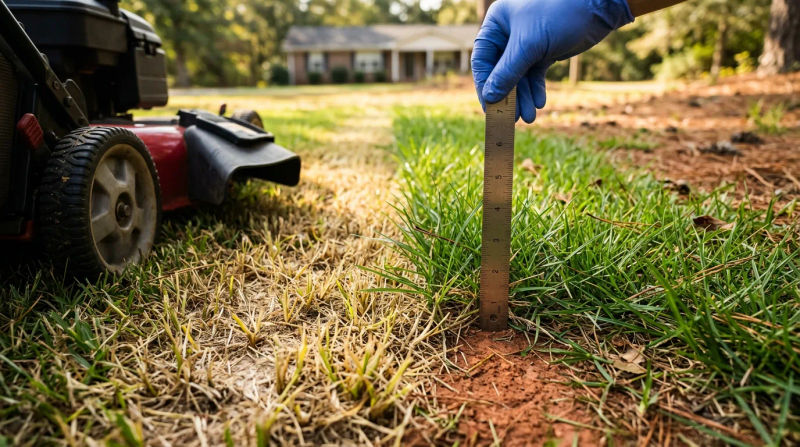
It’s a frustrating feeling. You’ve just spent time carefully mowing your lawn, expecting to step back and admire a neat, uniform carpet of green. Instead, what you see is a landscape of waves, ridges, and uneven patches. You might ask yourself, why my lawn looks wavy after mowing? It’s a common problem I see around Mitchell, and as a lawn care technician with over a decade of experience in this part of Georgia, I can tell you there are usually a few key culprits.
Especially here in October, as the frantic growth of our hot, humid summer starts to slow down, these inconsistencies become much more obvious. The good news is that this is the perfect time of year to diagnose what’s causing that uneven cut after mowing in Mitchell and get it corrected before your lawn goes dormant for the winter. Let’s walk through the signs to look for and what might be causing them.
Common Signs and Symptoms
An uneven cut isn’t just about one or two stray blades of grass. It’s a pattern that you can see across the entire lawn. When my team and I get a call about this, these are the typical things a homeowner describes:
- A Wavy or Rippled Look: From a distance, the lawn doesn't look flat. Instead, it seems to have gentle waves or ripples, almost like a sheet that hasn’t been pulled taut.
- Visible Streaks or Lines: You can clearly see distinct lines where the mower passed, with the grass between the wheel paths being cut at a different height.
- Random Tall Patches: After you’ve finished, you notice patches or tufts of grass that seem to have been missed entirely, standing taller than everything around them.
- Scalped Spots: These are areas where the mower has cut the grass so short that it exposes the soil or the brown, dead-looking base of the grass plant. This is particularly damaging to the turf.
- Shredded Grass Blade Tips: If you look closely at the individual blades of grass, they appear torn and frayed instead of having a clean, sharp cut. They might even have a whitish or yellowish tint a day or two later.
- Mower Ruts and Bumps Causing Uneven Grass: You can see visible indentations or tracks left by the mower's wheels, which often correspond with the highest points of the uneven cut.
If any of this sounds familiar, don’t worry. We can get to the bottom of it. The cause is usually related to your mower, your technique, or the ground itself.
What Causes This Problem
Over my years working on lawns in and around the Sandersville area, I’ve found that the reasons for uneven lawn mowing almost always fall into one of these seven categories. Many homes in the Mitchell area, particularly those built in the 1950s on large lots, have had decades for their landscapes to settle and change, which often contributes to these issues.
- Dull Mower Blades: This is, without a doubt, the number one cause. Dull blades don’t slice the grass; they tear and rip it. This violent action pulls the grass blades, resulting in a ragged, uneven finish. A torn blade is also more susceptible to disease and stress. You should be sharpening your mower blades at least twice a season - once in the spring and again mid-summer.
- An Unlevel Mower Deck: If your mower deck isn't parallel to the ground, it will cut the grass at an angle. One side will be shorter than the other, creating those distinct streaks and lines with every pass. This can happen if one side gets bumped or if the adjustment linkage is worn.
- Incorrect Tire Pressure: This is a simple fix that’s easy to overlook. If the air pressure in your mower’s tires is uneven, it will cause the entire mower frame and deck to tilt. Even a few pounds of difference between the left and right tires can lead to a noticeably uneven cut. Check them with a simple tire gauge and make sure they match the manufacturer's recommendation.
- Uneven Ground or Hidden Roots: This is a big factor, especially on established properties. Those beautiful, mature trees common on mid-century lots around Mitchell have extensive root systems that often run just below the surface. Over decades, these roots can push up the soil, creating subtle bumps. Likewise, the ground can settle and create low spots. When your mower goes over these, it rises and falls, causing it to scalp the high spots and miss the low ones. This is a primary reason for mower ruts and bumps causing uneven grass.
- Thick Thatch Buildup: Thatch is the layer of dead grass, roots, and other organic matter that builds up between the soil and the green grass blades. A thin layer is healthy, but a thick, spongy layer can cause your mower's wheels to sink in unevenly, leading to a wavy and inconsistent cut.
- Mowing Too Quickly: When you’re in a hurry, it’s tempting to push the mower as fast as it will go. However, moving too fast can reduce the blade's ability to create the lift needed to pull the grass blades up for a clean cut. The blades can skip over sections, leaving behind those random tall patches and contributing to a wavy appearance.
- Always Mowing in the Same Pattern: Consistently mowing in the exact same pattern week after week can train the grass to lean in one direction. More importantly, it compacts the soil along the wheel paths, creating ruts. Alternating your mowing pattern - diagonal one week, horizontal the next - prevents this and encourages the grass to grow more upright for a cleaner cut.
When to Call a Professional
Many of the causes of an uneven cut can be handled with some basic DIY maintenance. However, some issues require more expertise and specialized equipment.
You can likely handle these yourself:
- Sharpening Mower Blades: If you have a bench grinder and feel comfortable, this is a manageable task. Otherwise, many local hardware stores offer a sharpening service.
- Checking Tire Pressure: A simple tire gauge and an air compressor or bike pump are all you need.
- Leveling the Mower Deck: Your mower’s manual will have instructions on how to do this. It usually involves a few simple measurements and adjustments.
- Changing Your Mowing Speed and Pattern: This is a simple change of habit that costs nothing.
Consider calling for professional help when:
- The Ground is Significantly Uneven: If surface roots, bumps, and low spots are the main problem, a professional lawn care service can help. Solutions like topdressing (applying a thin layer of soil) or, in more extreme cases, regrading may be necessary.
- You Suspect a Heavy Thatch Problem: An experienced professional can determine if your thatch layer is excessive and perform core aeration or dethatching. These services are crucial for breaking up thatch and alleviating soil compaction, but they require specialized machinery.
- You’ve Tried Everything Else: If you’ve sharpened your blades, leveled your deck, and checked your tires, but the uneven lawn mowing problem persists, it’s time for a professional diagnosis. There could be a more complex issue with your turf health or soil condition.
Conclusion
Seeing a wavy, uneven lawn after you’ve put in the work to mow it can be disheartening, but it’s almost always a solvable problem. By starting with the simplest checks - your mower blades, tire pressure, and deck level - you can often fix the issue yourself. From there, consider your technique and the unique conditions of your property, from hidden tree roots to soil compaction.
Taking the time to diagnose the problem now, in the calmer days of October, sets your lawn up for a healthier, more beautiful start next spring. Don't wait for a small issue to become a major headache. Addressing the root cause will save you time and frustration in the long run, ensuring your hard work pays off with a lawn you can be proud of.
If you notice any of these signs and aren't sure where to begin, contact a local lawn care service for an inspection. An experienced professional can quickly identify the cause and recommend the right solution for your yard.